How to choose the ideal technology stack for a startup in 2026
Learn how to choose technologies for a startup based on MVP speed, costs, scalability, team capacity, and long-term maintenance.
- Startups
- Web Development
- Software Architecture
- Frontend
- Backend
- DevOps
- Databases
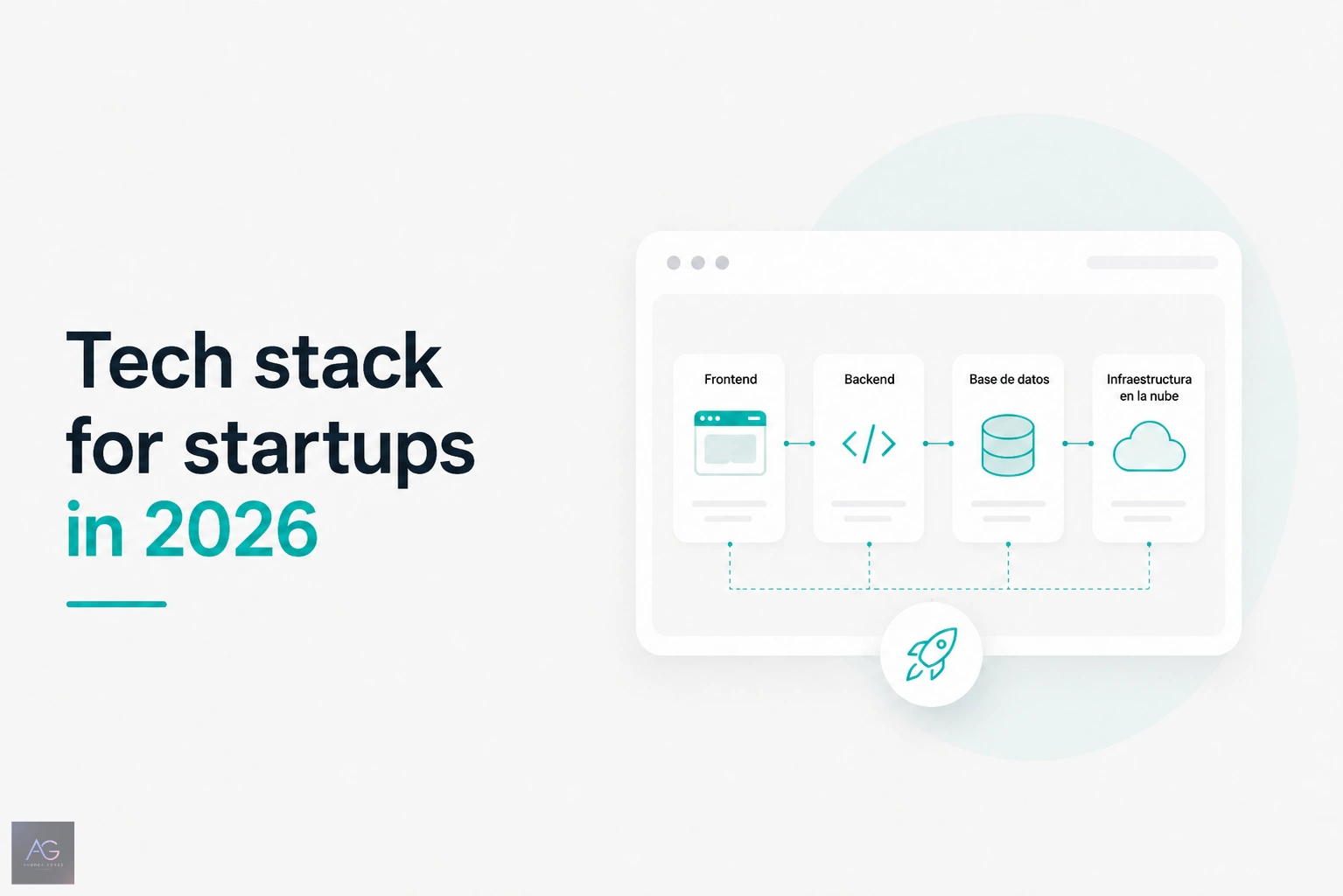
Choosing a technology stack for startups should not begin with a question like “which framework is trending right now?” but with a more strategic one: “what does this product need to validate quickly, stay stable, and grow without becoming impossible to maintain?”
Many startups make rushed technical decisions because they need to launch fast. That is understandable. The real problem appears when the chosen stack does not match the business model, the budget, the available team, or the type of product being built.
A strong stack has to balance development speed, scalability, maintenance, cost, hiring availability, and the team’s real experience. In this article I look at technologies such as React, Next.js, TypeScript, Node.js, .NET, PostgreSQL, MongoDB, Supabase, Docker, Vercel, and AWS, not to choose one universal winner, but to understand when each one makes sense.
What is a startup?
A startup is not simply a small company. It is an organization trying to validate a scalable business model under high uncertainty. Y Combinator focuses much of its educational material on helping founders understand users, build products, and move quickly through constant learning.
AWS Startups frames growth as a path from the first line of code to millions of users, combining technical guidance, business resources, and cloud scalability. Microsoft for Startups also focuses on helping founders build fast, scale intelligently, and access infrastructure such as Azure, credits, and technical support.
In practical terms, a startup needs technology that allows it to:
- launch quickly;
- validate hypotheses;
- change features without rebuilding everything;
- control costs;
- scale when traction appears;
- hire talent without depending on very unusual tools.
That is why the architecture needs to be flexible, but not unnecessarily complex.
Is there a perfect stack?
No. A perfect stack does not exist because every startup has different constraints. A B2B SaaS platform does not have the same needs as a social app, a marketplace, a validation landing page, or an internal operations system.
| Context | Priority | Better-fitting stack |
|---|---|---|
| Fast MVP | Speed and low cost | Next.js, Supabase, Vercel |
| SaaS with relational data | Integrity and maintainability | Next.js, Node.js, PostgreSQL |
| Enterprise product | Security and robustness | .NET, PostgreSQL, Azure |
| Product with flexible data | Frequent schema changes | Node.js, MongoDB |
| High global traffic | Scalability and infrastructure | Next.js, AWS, Docker |
| Content site | SEO and performance | Astro or Next.js |
The best decision depends on budget, product type, team experience, time constraints, expected scale, and user volume.
Frontend
React
React remains one of the strongest options for building modern interfaces. Its official documentation defines it as a library for building interfaces from reusable components. React
Advantages:
- large ecosystem;
- strong hiring demand;
- reusable components;
- solid integration with UI libraries;
- ideal for dashboards, admin panels, and interactive applications.
Disadvantages:
- it does not solve SEO, advanced routing, or server-side rendering on its own;
- it requires additional architectural decisions;
- it can become messy if the team has no internal standards.
When to use it:
React works especially well for products with heavy user interaction: CRM systems, dashboards, internal tools, SaaS products, or applications where dynamic experience matters more than static content.
Next.js
Next.js is a React-based framework that adds important capabilities for modern products: server-side rendering, static generation, routing, image optimization, APIs, and deployment-friendly workflows.
Its official documentation includes the App Router, Server Components, and current rendering models. Next.js It also supports ISR, which lets static content update incrementally without rebuilding the whole site. Incremental Static Regeneration
Key concepts:
- SSR: renders pages on the server to deliver updated content.
- SSG: generates static pages, useful for content that changes infrequently.
- ISR: allows static pages to regenerate after a set interval.
- App Router: organizes routes, layouts, and modern component patterns.
- SEO: improves indexation by delivering ready-to-read HTML to search engines.
- Performance: supports image optimization, streaming, and efficient loading.
Advantages:
- excellent for SEO;
- ideal for MVPs with growth ambitions;
- strong deployment experience on Vercel;
- allows lightweight backend logic next to the frontend;
- supports multiple rendering strategies.
Disadvantages:
- steeper learning curve than plain React;
- can become confusing if the team does not understand server/client components well;
- some decisions are strongly aligned with the Vercel ecosystem.
Why it is often a good fit for startups:
Because it helps teams launch quickly without sacrificing too much architecture. A startup can begin with static pages, forms, authentication, and simple APIs, then evolve into more complex features as the product grows.
React or Next.js?
If the product is an internal application, an admin panel, or an SPA where SEO is not very important, React with Vite may be enough.
If the product needs organic visibility, public pages, indexable content, strong initial performance, and frontend scalability, Next.js is usually a better choice.
My practical recommendation: for most startups that have a public site, a dashboard, and a need to grow, I would choose Next.js over plain React. Not because React is weaker, but because Next.js resolves more structural decisions from the start.
TypeScript
TypeScript adds static typing to JavaScript. In a startup it can seem like “extra work,” but in practice it reduces mistakes and improves maintainability.
For example, in JavaScript you might have:
function calculateTotal(price, quantity) {
  return price * quantity;
}
If someone sends "100" as text instead of a number, you can end up with unexpected behavior.
With TypeScript:
function calculateTotal(price: number, quantity: number): number {
  return price * quantity;
}
This helps catch problems before they reach production.
Advantages:
- reduces common errors;
- improves autocomplete;
- makes refactors easier;
- documents code intent more clearly;
- helps a lot as the team grows.
For a startup, TypeScript becomes especially valuable when the product moves from a tiny MVP to a real team-maintained codebase.
Backend
Node.js
Node.js is a JavaScript runtime that allows you to build servers, CLI tools, scripts, and web applications. Node.js
Advantages:
- same language on frontend and backend;
- huge package ecosystem;
- fast for building APIs;
- strong option for lightweight microservices;
- ideal for real-time products, integrations, and MVPs.
Disadvantages:
- it requires discipline to keep the architecture clean;
- it is not always ideal for CPU-heavy processing;
- the ecosystem can become scattered if the team does not standardize.
Node.js works very well when a startup needs speed, REST APIs, external integrations, webhooks, authentication, and moderate business logic.
.NET
.NET is a robust platform widely used in enterprise environments. Its ecosystem includes ASP.NET Core, Entity Framework Core, long-term support, and strong Azure integration. Microsoft maintains official support policies for .NET, ASP.NET Core, and Entity Framework Core. Microsoft
Advantages:
- high performance;
- strong typing through C#;
- solid security;
- excellent for enterprise systems;
- natural Azure integration;
- ideal for applications with complex business rules.
Disadvantages:
- it can be heavier for small MVPs;
- it requires people with specific experience;
- it often implies more structure from day one.
Which one should you choose?
For a web MVP with a frontend-leaning team, Node.js usually accelerates delivery. For an enterprise, financial, governmental, or rules-heavy platform, .NET can be a better long-term investment.
A realistic example:
If you are building a simple marketplace, Node.js may be enough. If you are building a management platform with permissions, audit trails, reports, and internal workflows, .NET can provide better structure from the start.
Databases
PostgreSQL
PostgreSQL is a very strong relational database. Its documentation defines ACID as atomicity, consistency, isolation, and durability, all of which are essential for reliable transactions under concurrency or failure. PostgreSQL
Advantages:
- excellent data integrity;
- clear relationships;
- powerful SQL queries;
- ideal for SaaS, payments, inventory, users, and permissions;
- good vertical and horizontal scaling with the right architecture.
For most SaaS startups, PostgreSQL is one of the most balanced choices available.
MongoDB
MongoDB uses JSON-like documents and allows more flexible data modeling. Its documentation also highlights sharding as a way to scale horizontally across large volumes of data and high throughput. MongoDB
Advantages:
- flexible structure;
- useful when data changes frequently;
- good option for catalogs, dynamic content, or event-heavy products;
- horizontal scalability.
Disadvantages:
- complex relationships can become harder to manage;
- it is not always the best fit for critical transactions;
- it requires careful design to avoid excessive duplication.
MongoDB makes sense when the data model is still moving a lot or when the application deals with variable document structures.
Supabase
Supabase does not replace PostgreSQL. It is a Backend-as-a-Service platform built around PostgreSQL. Its documentation explains that each project includes a Postgres database along with services such as Auth, Storage, Realtime, and Edge Functions. Supabase
It also offers Edge Functions, globally distributed TypeScript functions for webhooks and third-party integrations. Supabase Edge Functions
It is ideal for an MVP because it includes:
- authentication;
- a PostgreSQL database;
- storage;
- realtime;
- an admin panel;
- automatic APIs;
- serverless functions.
For an early startup, Supabase can save weeks of development. The caution is that teams should still understand PostgreSQL, security, Row Level Security, and usage-based cost growth.
DevOps and infrastructure
Docker
Docker lets you package applications and dependencies into containers. According to its documentation, a container is a runnable instance of an image that can be started, stopped, moved, or removed through the Docker API or CLI. Docker Documentation
Advantages:
- consistency between development and production;
- easier deployments;
- fewer environment mismatch errors;
- useful for teams and CI/CD pipelines.
It is not always mandatory for a tiny MVP, but it becomes very useful when there is a backend, a local database, workers, or multiple services.
Vercel
Vercel is especially strong for Next.js projects. Its documentation explains that it can integrate with Git and generate preview URLs for every pull request. Vercel
Advantages:
- fast deployment;
- built-in CI/CD;
- preview deployments;
- strong optimization for Next.js;
- a good experience for small teams.
Disadvantages:
- costs can grow with high traffic;
- it is not always ideal for complex backends;
- some architectures may require additional external services.
AWS
AWS offers a very broad cloud infrastructure for startups, from early stages to global scale. Its startup program talks about supporting companies from the first line of code to the first million customers. Amazon Web Services, Inc.
Advantages:
- huge variety of services;
- strong scalability;
- advanced control;
- ideal for complex products;
- enterprise maturity.
Disadvantages:
- learning curve;
- costs can be difficult to estimate without monitoring;
- stronger DevOps knowledge is required.
When should you move from Vercel to AWS?
When the product requires more customized architecture: queues, workers, heavy processing, private networks, enterprise compliance, multi-service infrastructure, or finer cost control.
The stack I would personally recommend for most startups
There is no single answer for every case, but for a startup trying to launch an MVP quickly and grow in a sustainable way, I would usually recommend:
Frontend
- Next.js
- React
- TypeScript
- Tailwind CSS
Backend
- Node.js
Database
- PostgreSQL
- Supabase
Infrastructure
- Docker
- Vercel
- AWS when the product grows
Why this combination?
Because it allows teams to build quickly, maintain a strong user experience, protect SEO, reduce mistakes with TypeScript, launch with controlled costs, and migrate progressively toward more robust infrastructure.
Next.js helps with frontend and SEO. Node.js speeds up APIs and integrations. PostgreSQL provides a reliable structure for critical data. Supabase helps validate ideas without building everything from scratch. Docker prepares the project for more consistent environments. Vercel simplifies deployment. AWS becomes the natural path when the product needs more control.
When should you choose a different stack?
There are scenarios where a different decision makes more sense:
- .NET: enterprise products, complex business rules, Azure-heavy environments.
- Angular: corporate teams that prefer more structured frameworks.
- SvelteKit: smaller products where simplicity and high performance matter.
- Astro: content websites, landing pages, blogs, and portfolios with very strong performance.
- Firebase: mobile MVPs or products that need quick realtime capability.
- Azure: companies already integrated into the Microsoft ecosystem.
The point is not to choose the most popular tool, but the one that best fits the real problem.
Common mistakes when choosing technologies
Choosing based on hype
Using a technology only because it appears often on social media can create technical debt. The first step should always be understanding the product.
Overengineering
You do not need Kubernetes, microservices, and event-driven architecture to validate a landing page with a form.
Ignoring hiring realities
A very unusual stack can make hiring slower. For startups, being able to hire quickly is also a technical advantage.
Ignoring cloud costs
Serverless functions, managed databases, and edge functions are useful, but their costs can grow quickly. Monitoring from the beginning matters.
Choosing too many technologies
Every new tool adds maintenance. A simple stack used well usually beats a complex stack integrated poorly.
Ignoring maintenance
The MVP does not end when it launches. There are bugs, changes, support needs, security work, and new features. The stack has to allow evolution.
Conclusion
The best technology stack for startups is not the most popular one or the most modern one. It is the one that helps the business learn, launch, sell, and grow without blocking the team.
For many products, a combination built around Next.js, TypeScript, Node.js, PostgreSQL, Supabase, Docker, and Vercel can be a very balanced starting point. But if the context changes, the decision should change too.
Before choosing tools, it helps to answer: what are we building, for whom, how quickly do we need to validate, what budget do we have, who will maintain it, and how large could the product become?
At goraz.dev you can also explore real web development work in the projects section and continue reading related articles about frontend, architecture, and web optimization.